


Business Management Dashboard
One system across sales, pre-sales, project management, operations, procurement, finance and the executive view. Every department works in its own screen, and the numbers move through the business by themselves.
Test the software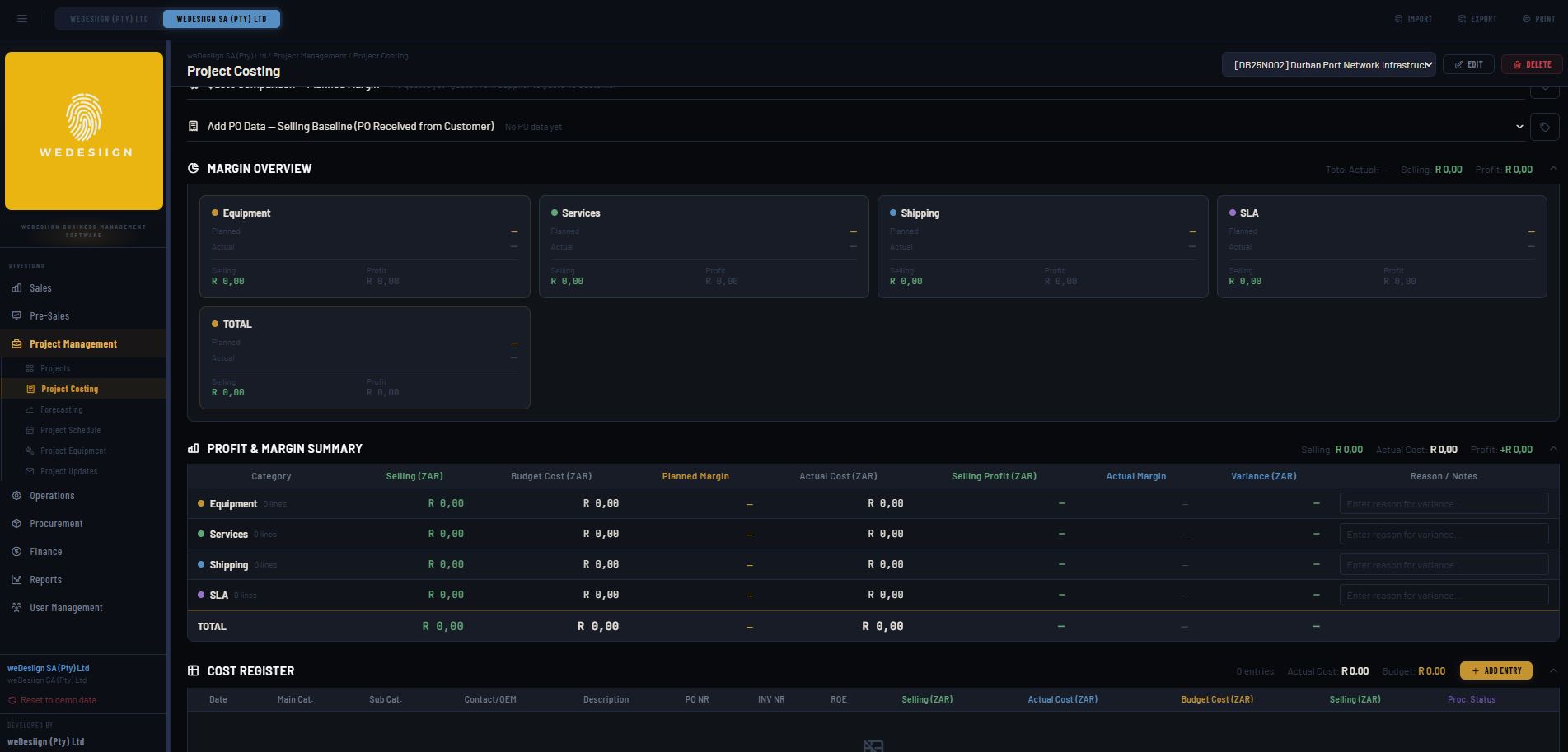
The problem it solves
Most growing businesses do not lack information. They have too much of it, in too many places. Sales keeps a pipeline in a spreadsheet, pre-sales quotes from a template on someone's desktop, project managers track progress in a chat group, procurement works off emailed purchase orders, and finance rebuilds all of it at month end to find out what the business actually earned. Every handover between departments is a retyping exercise, and every retyping is a chance to be wrong.
The cost is rarely a single dramatic failure. It shows up as a quote that went out at last year's rates, a project that ran over because nobody saw the variation order, stock ordered twice, an invoice raised a month late, and an owner making decisions on figures that are three weeks old.
This dashboard was built to close those gaps. One record of a client, a quote, a project, a purchase order and an invoice, entered once and visible to every department that needs it, at the level of detail that department needs.
Every department, one system
Each module is a working environment for the people in that role, not a report about them. Data entered in one flows to the next without a hand-off.
Local and international, on your terms
Thinking behind the design
Business systems fail on adoption, not on features. If a project manager has to open four screens to do the thing they do forty times a day, they will go back to the spreadsheet, and the moment one department opts out the whole chain of data breaks.
So each module was designed around the one task that role repeats most, with everything else a click away rather than in the way. Screens are dense where the work is dense and quiet where it is not, and nothing asks for a number the system could already know.
The owner's screen leads with the four figures that decide the next month: what has been sold, what is still to be delivered, what it is costing, and what is in the bank. Every one of them is drillable down to the transaction, so a surprising number can be explained in the same sitting rather than in a follow-up meeting.
Sales sees a pipeline, procurement sees orders, operations sees jobs. They are looking at the same records from different angles, with the fields their role owns editable and the rest visible but locked. That is what keeps one department's discipline from becoming another department's admin.
Built around your business, not the other way round
Off-the-shelf platforms ask you to change how you work. This is built to the process you already run, then improved where the process is the problem.